

CATHEDRAL PROJECTS
Lessons from the Sagrada Familia

Last month, the exterior of Barcelona’s Sagrada Familia was finally completed: 144 years after it had begun and 100 years since the death of its most famous architect, Antoni Gaudi. Work still remains to be done on the interior and, like all such monuments, the cathedral will remain in a constant state of repair and restoration.
I’m not a big fan of the building; I find it visually aggressive and garish. And I’m in good company; Picasso detested it, Orwell confidently thought it ‘one of the most hideous buildings in the world’ while Gerald Brennan, a great writer on Spanish culture, observed that ‘Not even in the European architecture of the period can one discover anything quite so vulgar and pretentious.’
But I don’t have to like the architecture to admire what the cathedral represents: endurance, ambition, belief and the human capacity to imagine and to build on an immense timescale. This is a defining characteristic of great cathedrals. Notre Dame took 97 years, which might not seem very long—until you consider that, in the 12th century, 97 years encompassed 3 human lifetimes. So the people starting it knew, at its inception, that they would not live to see its completion. Most of the great cathedrals of Europe took hundreds of years to complete and all have had to adapt to changes in religion, politics, technology and fashion—and they still must, for legitimacy and existence.
When successful, what seems to keep them on course is a seemingly paradoxical combination of determination and flexibility, together with broadly shared principles demanding that the best be allowed to emerge and be improved over time. Starting from principles rather than a plan, outcomes come to be seen not as ends in themselves but as landmarks showing where they are so far. Economics are far from irrelevant but they aren’t the sole measure of worth. The leaders of such projects map the future not by trying to pre-empt, co-opt or nail it down, but by believing in it, confident of exploring whatever awaits finding. With aspirations too great for an end date, such institutions sustain people by making them feel important, doing work that lasts and that matters. In all of this, they stand in startling contrast to many conventional institutions.
Ten years ago this month, this combination of ambition, vision and longevity is what caused Stephen Hawking, to champion what he called ‘cathedral projects’: ideas started by one generation in the expectation that future generations will take up and continue to address their big challenges. CERN is one such project, begun at the end of World War 2 to explore, discover and invent the peaceful uses of nuclear physics. What struck me most when I visited was that its big attraction for young scientists wasn’t the novelty of the engineering or the size of the machinery required to do mind-bending experiments—but the sheer difficulty of the science. Investing creative years of a career in questions that might never be answered was a certain risk. But that the work would be difficult wasn’t an obstacle; it was the draw: to be part of something great, beyond economic benefit, beyond time itself.
Many of the world’s universities are cathedral projects too, now visibly struggling to find and articulate their meaning and relevance in today’s world. That means they must—as the Sagrada Familia has had to do—stay loyal in the dedication to an original concept but be prepared to adapt to changing needs, populations and technologies, if they are to endure long into the future as living proof of human capacity, imagination and faith. Had it clung to the past, to every iota of Gaudi’s designs, the Sagrada Familia could never have been completed. As such, it illustrates eloquently what cathedral projects require and what it takes to keep vision, ambition and commitment alive.
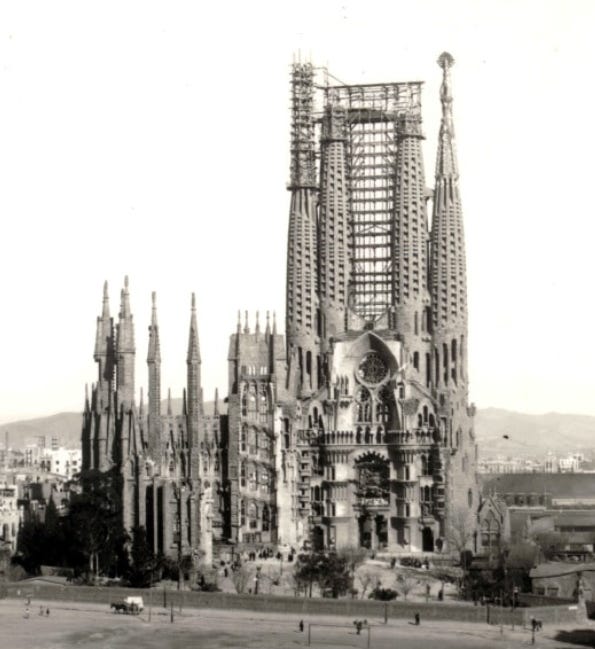
Leaving behind detailed drawings and plaster models, Gaudi had hoped that his designs would guide his assistants to the end of the project. But that plan never took politics into account. Even before his death in 1926, churches had become targets for violence and revenge. Only local love for the Sagrada Familia left it unscathed. Yet even that support fractured in the Civil War. In 1936 the Iberian Anarchist Federation (FAI) attacked the church, burned down Gaudi’s office, smashing plaster models and sculptures, destroying notebooks full of calculations. Correspondence and writing that detailed Gaudi’s intentions were trashed. Twelve people associated with the Sagrada Familia were killed and two years later Domenec Sugranes, Gaudi’s assistant who had loyally continued the work, died. By 1939, the crypt had been turned into toilets.
Peace, of a kind, came with Franco’s rule, but his hatred of Catalonian republicanism prohibited any state funds or support for the Sagrada Familia. In the 1940s, when starvation was used as a weapon against dissidence, black-and-white photographs show tiny old women on the street, selling cakes and raffle tickets as they try to raise meagre funds for the extravagant fragments of a church that dwarfs them. Supported by nothing but the will of its citizens, Barcelona’s unfinished building became an icon of persistence, devotion and endurance.
In the 1950s, fundraising and sculptural work started to gain some momentum as Gaudi’s remaining followers and acolytes struggled to piece together his original vision. An archive and a small museum brought together what remained of his notes, drawings and plans. By the 1960s, that began to attract curious visitors. But in 1965, such persistence drew still more ire from young intellectuals and architects, including Joan Miro, Alvar Aalto and Le Corbusier. Little money. No critical support. Gaudi was dead, his style was dead, the building had no future. Only the city’s deep identification with the cathedral eked out resources sufficient to keeping its construction going. The chief architect Francesc de Paula Quintana continued his work until he died in 1966, aged 74.
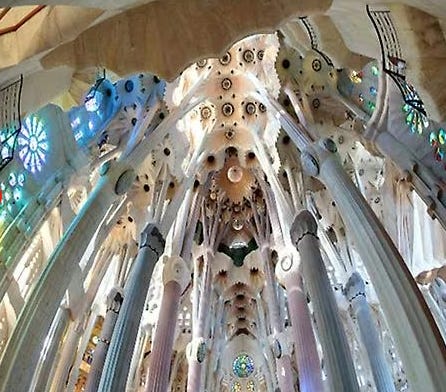
After the death of Franco, Spain began to open up to tourism. Gaudi’s unexpected motifs of trees, flowers, foliage and fruits, turtles, birds and signs of the zodiac thrilled a new, young generation of visitors. When the Olympics came to Barcelona in 1992, over a hundred nationalities visited the basilica and went home exclaiming over the crazed, hallucinogenic use of colour and geometry. Charging for admission meant that, for the first time, it wasn’t just the citizens of Barcelona who would pay for the church to be built. Now the whole world did. What had once been a local expression of devotion to the Holy Family as a symbol of shared humanity was now seen around the world as a potent articulation of the universal capacity to endure and adapt.
Gaudi’s designs were not just visually startling. They depended on extreme manipulations of geometry: paraboloids, hyperboloids and helicoids, often combined at a level of complexity that can’t be seen by the naked eye. What Gaudi had envisaged, it turned out, could never have been built using the technologies available to him at the time. But by 1980, computer-aided design made the 3D mapping of each part of the building both easier and faster. Laser cutting, computing, and automation—none of which Gaudi could possibly have imagined—all accelerated the work of growing teams of engineers and builders. For the first time in its history, the Sagrada Familia started to make the transition from chimera to reality and in 2010, the basilica was finally consecrated.
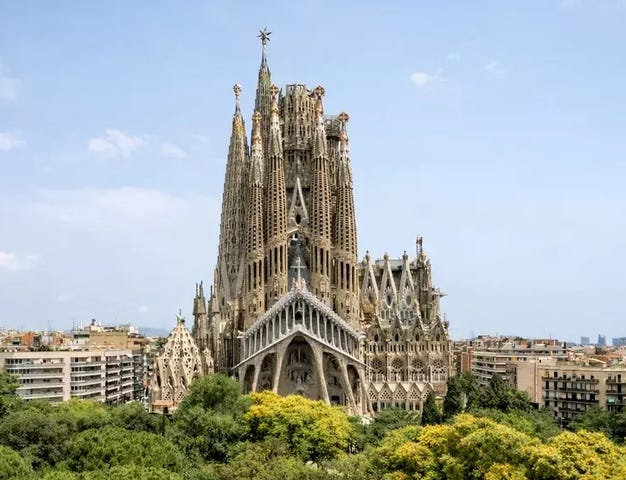
With income of 50 million euro a year, tourist revenue provided ample funding—but the influx of sixteen thousand daily visitors meant that construction couldn’t continue safely. Stop the tourists – no money for construction. Stop the building work – the tourists dry up and the building is never finished. Stopping the weekly mass wasn’t an option, worship was what the building was for. Once again, the Sagrada Familia seemed impossible.
One firm proved capable of solving his problem. In the City of London, a site for a new skyscraper nicknamed ‘The Cheesegrater’ had been so tightly hemmed in by existing buildings that it had to be constructed offsite, then disassembled, trucked in piece by piece overnight and re-assembled. The engineers who pioneered this form of construction worked for young, a company famous for its stated principle of only working on projects that matter. After a hundred years of dogged devotion, there was no doubt in anyone’s mind that the Sagrada Familia mattered.
In 2017, I visited the offices from which the project was managed: a conventional office far from Gaudiesque, with stark white walls, modern steel furniture, rows of desks and computers, it could be any business. CEO Martinez’s office was ordinary too except, perhaps, for the crucifix on his wall. To him had fallen the challenge and, in his eyes, the rare gift, of finally being able to promise a completion date for the church: 2026, one hundred years after Gaudi’s death. After all the vicissitudes of its constructions, I asked, was he confident that now it can finally be finished?
“Oh sure,” he said, putting quote marks around his words and laughing. Sure, he indicated had never been a word associated with this project; Martinez knew that completing the building by 2026 would still require a few miracles. The foundations of the original church had been designed for a building 70 metres high; Gaudi’s design called for a height of 172.5 metres. Reinforcing the foundations wouldn’t solve the problem entirely. Instead, the towers have to be much lighter, their thickness reduced from two meters to just 300 millimetres, using materials that simply didn’t exist when Gaudi was alive. Out of town, the construction site, where the new pieces of the cathedral were being made, looked more like a car production line than a church. It was here that workmen rehearsed assembling each addition so that, when the parts were trucked into the city, adding them to the cathedral was quick and safe. Mixing modern materials with traditional craftsmanship demanded huge flexibility in everyone’s thinking. For the most part, the crew was optimistic that the building would be completed on time. But one young sandy-haired engineer, Esteve Umbert, acknowledged that after such a long and troubled past, nothing was guaranteed.
“It is really a challenge but you never know,” he said, smiling, “The story can always change. But you fall in love with the challenge. There’s meaning in the work. My work will be there for hundreds of years….”
For Martinez, the completion of his project, on time, would be a huge cause for celebration. But in 2017 he was already thinking past that date. The cathedral would live on and he would be 57. He thought it unlikely he would ever find so demanding, or so rewarding, a job again. Most of his workforce wouldn’t be needed anymore and his last task would be managing the winding down of the organization he had created.
“To do well the things that matter, that is my job. That is enough,” Martinez said. “You know, our local business school, IESE ran an executive programme, spending a week in the U.S., visiting Amazon, Google, Microsoft. And then they visited this. There was a lot more to explain here! Values. Sticking to Gaudi’s values. At Microsoft, it is the bottom line that pushes things. If I were a manager at Microsoft or Google, my main preoccupation would be my salary. At Sagrada Familia, that isn’t important. What is important for us is a higher idea. We need self-discipline. We need self-criticism. We need to do whatever we do better always. That’s what we worry about.”
Once completed, Martinez will no longer decide how the cathedral’s funds are spent; that job transfers to the Bishop. Restoration will always absorb a lot – but where will the rest go? The people of Barcelona and the people of the world feel that they own this church, they have sustained it all this time. This will be another test for the project: whether it can maintain its legitimacy into the future, when it is no longer the work of the people. There are no guarantees. There never have been.
Why do I find this story so much more compelling than the building itself? Largely because it demonstrates how much, in fact, we are capable of in the face of complexity and uncertainty. While we may crave guarantees, we don’t need them to function, even on a grand scale. To do well, in the words of Martinez, in the things that matter for future generations; to be capable of invention, discovery and adaptation—not clinging to outmoded orthodoxies or the fickleness of fashion; to to defend principles in the face of economic temptations, and ambition on behalf of future generations: these are the hallmarks of cathedral projects.
Uncertainty need not be paralyzing. It even sparks a provocative question: are the guarantees to which consumers, shareholders, managers and governments are now so avidly addicted, in fact what constrains our capacity to think for ourselves and to imagine something better? Are the Taylorist performance managements systems that managers cleave to in fact not the solution to today’s uncertainties but perhaps instead a major cause of the problems they confront, stifling imagination and obliterating meaning? In confronting uncertainty, today’s leaders seem drawn more to excruciatingly detailed, efficient short term thinking than to bolder, brighter thoughts. This frequently strikes me as exactly the wrong instinct, a strategy driven by a need for control and a lack of imagination.
Of course every company, institution or organization isn’t a Sagrada Familia—if only because few last longer than a single lifespan. They’re more likely to conform to Peter Drucker’s uncomfortable notion of companies ‘like tents’. But even before I went to Barcelona to meet Martinez and his team, I wondered at the addictive allure of Silicon Valley dominant values: convenience and speed in particular. As though a great life would just be a convenient one, where everything was quick and easy. And now we have much of what we were promised: a life so convenient we need not talk to anyone or leave our homes. As far as ambition goes, convenience is pretty low grade. It doesn’t seem to be deeply fulfilling. And nor does the speed of work when we can’t remember on Tuesday what we did, or read, or thought on Monday because it all flew by so fast: frictionless but ephemeral. In contrast to the Sagrada Familia the image that floats in my mind today is driving though the Palisades in LA, where my host pointed out castles, chateaus, haciendas and Tudor cottages, all “tear downs” built, bought, demolished to be replaced by some new temporary fake. Recalling that drive, Martinez’s words echo in my mind: “What is important is a higher idea. We need self-discipline. We need self-criticism. We need to do whatever we do better always...”
Where do you see today’s cathedral projects? The big three front of mind for me now are climate, democracy and education. Great challenges desperately in need of unshakeable, radical innovation and an serious, indefatigable ambition to create meaning for generations of human beings. Not because it’s easy. But because it’s hard. And because it matters.

If You Want to Go Deeper
There is a very good history of the building by Gijs vans Hensbergen, a knowledgeable commentator on modern Spain and its art. There are also a few more recent ones, which I haven’t read, and many guidebooks.
For the Love of It
For reasons entirely unrelated to the Sagrada Familia, my husband and I have spent some 7 years visiting every cathedral England and Wales. There are 48 of them and we’ve just 2 left to see: Bristol (too close to us to bother scheduling) and St. Paul’s in London, which we have resisted due to its vile £24 entrance charge. We will get to both by the end of the year and draw a line.
This has been a fascinating lens through which to see both the past and present state of the nations. When we began, greeters were rather amazed to hear of our project but now the Church of England has brought out a ‘passport’ which grants you a sticker for each building you visit. I’m not much for stamp collecting but if it encourages visits to these great and aspirational buildings, I’m all for it.
And in case you’re wondering, no this is not the subject of my next book.